The short answer: $50–$150 an hour, about $405 for a typical job
If you searched "how much does a handyman cost per hour," here is the honest national picture first. Angi's 2026 handyman pricing guide — built from 103,764 verified projects — puts the average handyman job at $405, with a typical range of $164 to $647, and labour itself at $50 to $150 an hour. Coastal Georgia sits comfortably inside that range: Savannah and its suburbs price like a mid-size metro, while smaller towns toward Hinesville and the Fort Stewart corridor tend to land in the lower half. What you should not expect is a single hourly number that covers everything, because how a pro charges matters as much as the rate itself. The rest of this guide breaks down the two pricing models, the real flat prices for the jobs everyone actually books, and how to walk away with a number you can hold someone to.
Two ways handymen charge — and what each really totals
Hourly billing sounds simple: a rate, a clock, a total. In practice it comes with a minimum charge and often a trip fee, and the clock runs while the pro drives to the hardware store for the part nobody knew was broken. Flat per-job pricing flips the risk: you agree on one number for a defined scope before work starts, and if the job takes longer than expected, that is the pro's problem, not yours. Hourly makes sense for open-ended work — a punch list of ten small items, or a repair whose cause is still unknown. Flat pricing wins for defined jobs: mount this TV, patch this wall, swap this fan. The trap is comparing an hourly quote against a flat quote as if they were the same product. A $60-an-hour quote with a two-hour minimum and a trip fee can finish above a $275 flat price that simply gets the job done.
What the common jobs actually cost
These are published national flat-price ranges for the small jobs that fill a handyman's week, compiled by Housecall Pro in September 2026. Treat them as a fairness check on any quote you receive: a price far above the range needs a reason (height, wall type, access, materials), and a price far below it usually means something is being left out — the mount, the patch texture match, the haul-away, or the return trip to finish.
| Job | Typical flat price | What moves it |
|---|---|---|
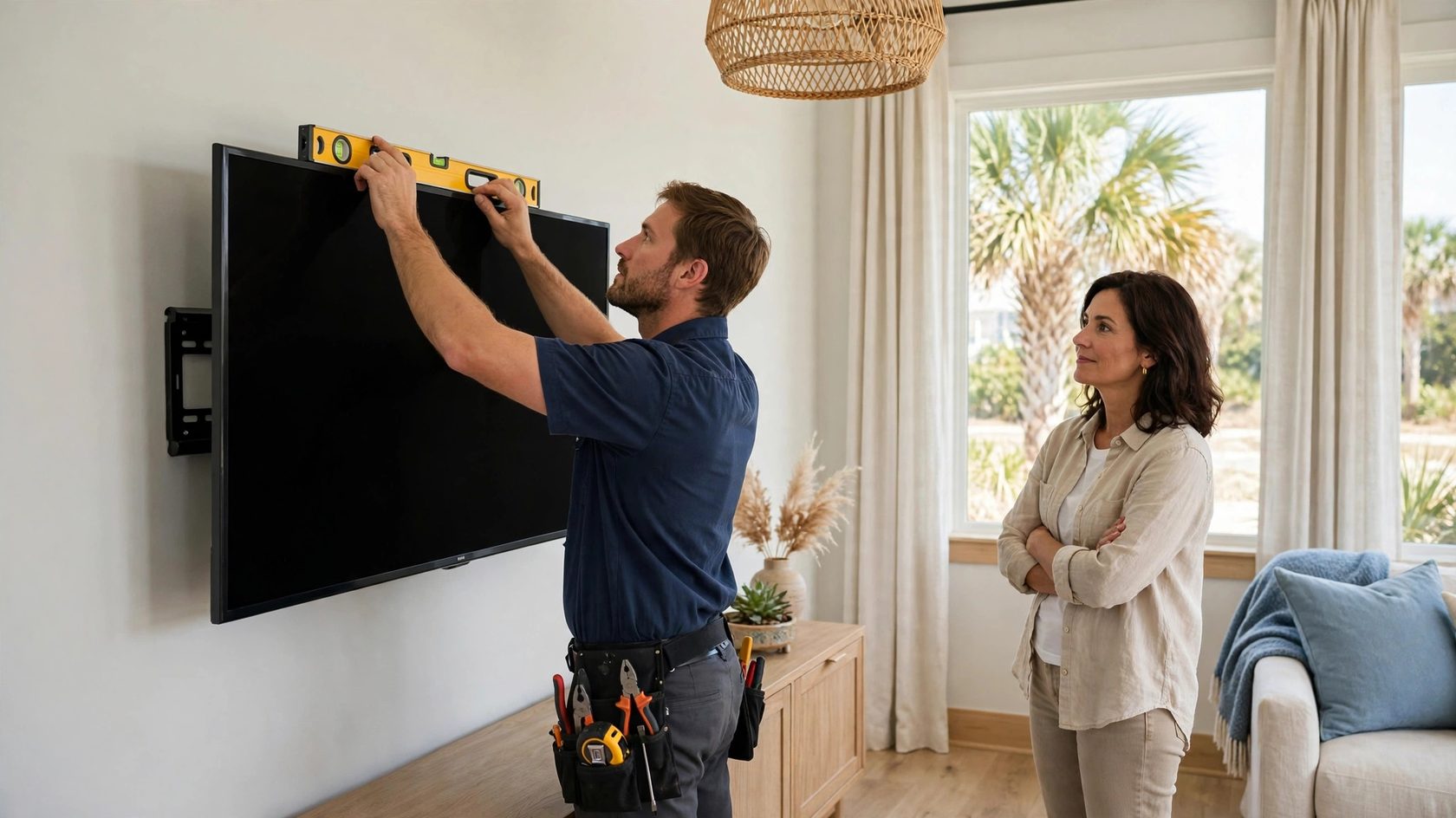
| TV mounting | $150–$300 | TV size, wall type, hiding cables in the wall |
| Ceiling fan installation | $200–$450 | Ceiling height, existing wiring and brace |
| Small drywall repair | $150–$350 | Hole size, texture and paint matching |
| Furniture assembly | $100–$300 | Piece size and complexity — wardrobes top the range |
| Grab bar installation | $200–$350 per bar | Must anchor into studs or blocking, rated for 250 lb |
What moves a job up or down inside the range
Two identical-sounding jobs can honestly price $150 apart. A ceiling fan on an 8-foot ceiling with an existing rated box is a different job from the same fan over a stairwell on a 14-foot ceiling. Drywall over studs prices differently from drywall over the plaster-and-lath you find in older Savannah homes. Access matters: a water shutoff you can reach beats one behind a seized valve in a crawl space. Materials matter too — a pro supplying a quality mount, fan brace, or matching fixtures is not padding the bill; they are saving you a second trip. When a quote lands high in the range, ask which of these factors is driving it. A good pro can point to the reason in one sentence. A vague answer is information, too.
The minimums and trip fees nobody puts in the ad
Most established handymen charge a minimum service fee of $125 to $200 and a trip fee somewhere between $30 and $80 — those are Housecall Pro's published 2026 benchmarks, and they exist for a fair reason: a 20-minute job still costs the pro an hour of driving, setup, and paperwork. Where homeowners get burned is not the minimum itself; it is discovering it after the work is done. Before you book anyone, ask three questions: What is your minimum? Is there a trip or service-call fee, and is it inside the quote or on top of it? If you find more damage once you open it up, how do we handle the price? Written answers to those three questions separate a professional operation from a gamble, every time.
Why the cheapest quote is rarely the cheapest job
A rock-bottom quote usually wins by subtraction: no insurance, no written scope, no cleanup, no warranty — and no intention of coming back if the repair fails. If a worker who carries no insurance is hurt on your property or a cheap patch leaks into the wall, the real bill arrives later and it has your name on it. This is also where licensing quietly matters: in Georgia, some work that gets handed to "a guy with a truck" legally belongs to licensed trades above set thresholds, which is why we wrote a separate guide to checking a Georgia contractor's license. The cheapest quote is a fine starting point for questions. It is a poor place to stop asking them. Judge quotes on what is included, what is guaranteed, and what happens when something goes wrong — then compare the numbers.
Coastal Georgia changes the estimate
Our climate writes its own line items. Humidity swells doors until they stick, rots trim from the inside, and turns a small drywall patch into a mold question if the moisture source is still active — a pro who quotes the patch without asking about the leak is quoting half the job. Termite-adjacent repairs are the other local surprise: cosmetic termite damage repair in Georgia commonly runs $500 to $2,000 once a pro opens the wall, and structural work goes up from there, so discovery clauses matter here more than almost anywhere. Around Fort Stewart, PCS season adds a time factor: move-out repairs bunched into a two-week window before a clearing date are worth booking early, because every handyman in Liberty County is looking at the same calendar you are.
How to get a price you can hold someone to
Three habits turn a quote into a commitment. First, send photos with measurements when you ask — most small jobs can be priced accurately from good photos, and a pro who has seen the job cannot un-see it later. Second, get the scope in writing: what is included, what is excluded, who supplies materials, and what happens if hidden damage appears. Third, agree the price before work starts — not a range, not an estimate that breathes, a number. That is exactly how Coastal Repair Squad is built: the price is agreed up front, the finished work is verified with photos, and payment is released after you approve it (or automatically 48 hours later). Georgia is our first market and an area opens for booking only while a verified pro there is accepting jobs — if your area is not open yet, joining the waitlist costs nothing and holds your place.
Is it cheaper to hire by the hour or by the job?
For one defined task — a fan, a mount, a patch — a flat per-job price is almost always the safer buy, because the risk of a slow job sits with the pro. Hourly billing earns its keep on punch lists: eight small items across three rooms price badly one by one (eight minimums) and well as a half-day of hourly work. Many homeowners search for a "handyman price list" hoping for one page of fixed numbers; the table above is the honest version of that page, because any real list is a set of ranges with reasons attached. If a pro will only quote hourly for a simple, well-defined job, ask why. Sometimes the answer is legitimate — concealed damage is a real thing — but you deserve to hear it before the clock starts, not after.
Should you buy the materials yourself?
Sometimes. Buying your own TV mount, fan, or fixtures can save the pro's materials markup, and it guarantees you get the exact model you wanted. But it carries two risks: if the part is wrong or defective, you own the delay and the second trip — and the pro's warranty covers their labour, not your part. For anything with a fit or finish that matters (faucets, valves, matching hardware), let the pro supply it and warrant the whole job; pros also mark materials up 20 to 50 percent in published benchmarks, which is a standard, disclosed part of the trade, not a scam. The cheapest arrangement is the one agreed in writing before anyone drives to the store: who buys what, what brand, and what happens if it fails.