You are not imagining it: reliability is the industry's weak spot
If you searched "how do i find a reliable handyman" after a bad experience, you have company. A Leaf Home survey reported in February 2025 found that roughly 70% of homeowners worry about unreliable contractors, 41% say they have been misled by a service provider, and the most common complaints are jobs left incomplete, poor communication, and professionals who simply fail to show up. Consumer Reports' survey of 913 homeowners put failing to show up at the very top of remodeling complaints — ahead of cost overruns. The lesson is not that most pros are dishonest; it is that hiring on a handshake and a hope is a broken process. Reliability is something you can screen for before money moves. This guide is that screen: how to compare quotes properly, which red flags end the conversation, how deposits should work, and why proof of work matters more than promises.
Why three quotes for the same job come back 3× apart
Homeowners are told to get three quotes, then stare at numbers like $180, $340, and $525 for "the same repair" and learn nothing. The quotes are rarely for the same job. One includes patching, texture, and paint; another is patch-only. One pro carries liability insurance and a warranty; another carries a ladder. One priced the materials you actually need; another priced the cheapest version and plans to renegotiate in your kitchen. Price differences also hide exclusions: disposal, a second visit for paint after the patch cures, the part behind the wall that is probably also failing. Before you compare a single number, force every quote onto the same scope — the checklist in the next section does that — and treat any pro who refuses to itemise as having answered your question already.
The apples-to-apples quote checklist
Send every pro the same photos and the same written description, then require the quote to speak to each row below. You are not being difficult; you are being comparable. A professional expects these questions, and the answers become the written scope you both rely on if anything is disputed later.
| Ask for this, in writing | Why it matters |
|---|---|
| Labour and materials as separate lines | Stops a cheap headline price hiding expensive 'extras' later |
| A start date and a realistic timeline | A quote without a date is how no-shows are born |
| Who buys the materials, and which ones | Prevents wrong-part delays and arguments over quality |
| Cleanup and disposal included or not | Debris in your driveway is the most common 'surprise' charge |
| What happens if hidden damage appears | The honest answer is a pause, photos, and a revised written price — agreed before extra work |
| Warranty on the work, and for how long | Separates pros who stand behind work from pros who vanish after it |
Seven red flags that should end the conversation
Angi's scam guide (updated July 2026) and FTC consumer guidance converge on the same warning signs. One: a demand for full payment up front. Two: cash only. Three: no written contract — or resistance to signing one. Four: pressure to decide right now. Five: the "leftover materials from another job" story, usually paired with a too-good price. Six: an unsolicited visit offering to fix something you had not noticed. Seven: an extremely low bid that cannot survive the checklist above. Any single flag deserves a hard question; two together deserve a goodbye. Legitimate pros are busy, carry insurance, and are happy to put things in writing — the red-flag operator's whole business model depends on you not asking.
Deposits: what is normal, and what is a walk-away
Deposits are where homeowners lose the most money, so be precise. On a small repair, a deposit should be small or nonexistent — the job itself is the commitment. On larger work, a partial deposit that covers special-order materials can be reasonable, especially when it is tied to something you can verify: an invoice for the materials, a scheduled date, a signed agreement describing exactly what the deposit buys. What is never reasonable: the full price in advance, a deposit in cash with no paperwork, or a deposit that grows when you ask questions. Pay by a method that leaves a record. And hold the final payment — whatever the schedule — until the work is complete and you have seen it. Money you still hold is the only leverage that works after the truck leaves.
The no-show problem — and what actually prevents it
No-shows are rarely personal; they are structural. A pro who bought your request as a shared lead — the same request sold to several competitors — has little invested in your Tuesday at 9 a.m., and a bigger job that morning wins. Double-booking is the rational response to a system where most leads go nowhere. What changes the math is commitment on both sides: a named pro who has seen your job, accepted that specific job, and agreed its price, with your payment secured but not yet released. That is the structure we built Coastal Repair Squad on: your request is not resold, the pro accepts the actual job before anyone is booked, and because their pay depends on completing your job — not on winning a lead lottery — your appointment is the one that matters that morning.
Proof of work: photos before anyone gets paid
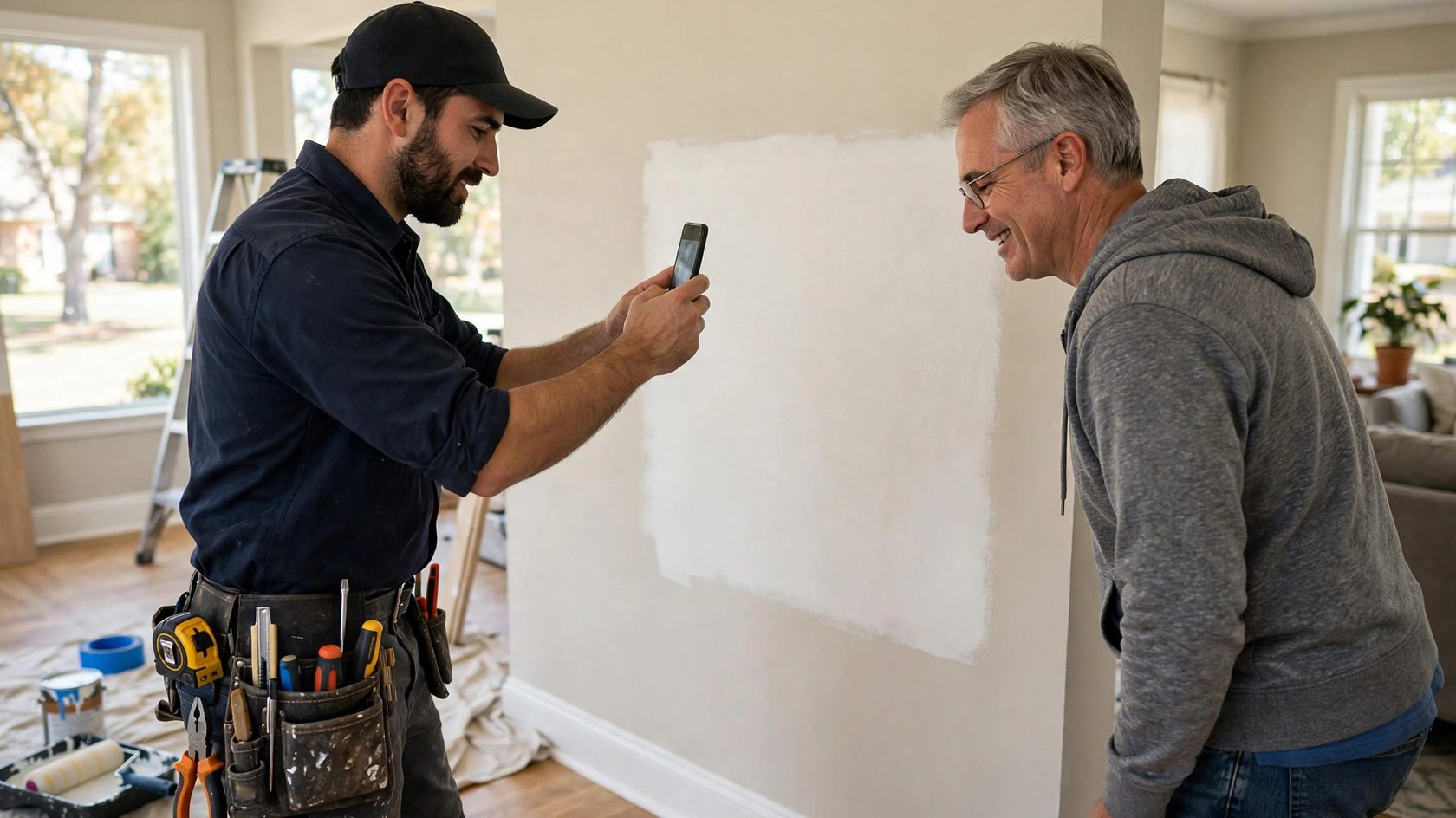
The single most protective habit in home repair costs nothing: photographs. Before photos document the starting condition, progress photos catch problems while walls are still open, and after photos are the receipt that the scope was finished. Ask for them as a condition of final payment, and compare them against the written scope line by line. On Coastal Repair Squad this is not a favour you request — it is the mechanism itself: the pro checks in and photographs the job, completes it with after photos, and the payment is released only after you approve the work, or automatically 48 hours later if you do not respond (a dispute pauses that clock). Behind it sits a 90-day workmanship warranty and a re-do fund, so a covered failure means a re-do or a refund — your choice — instead of an argument.
If a contractor has already taken your money
If you are reading this section too late, act in order. First, document everything now: the agreement, texts, photos, payment records, and the current state of the work, before anything else changes. Second, make one clear written demand — email counts — stating what was agreed, what was paid, what is unfinished, and a reasonable deadline to complete or refund. Third, use the official routes: Georgia's Consumer Protection Division takes complaints about unfair practices, and work that required a state license can also go to the relevant licensing board; a chargeback through your card issuer may be available if you paid by card. This is general information, not legal advice — for significant sums, a consumer attorney's one-hour consult is money well spent. The pattern to notice: every remedy works better with the paper trail from the sections above, which is why the process matters before you hire, not after.
The reliable-hire checklist, in one pass
Here is the whole system on one page. Get three quotes against the same photos and written scope. Require itemised labour and materials, a date, a cleanup answer, a hidden-damage answer, and a warranty. Walk away from the seven red flags, and never pay in full before completion. Use pros whose verification you do not have to take on faith — licence where Georgia requires it, insurance, a signed agreement, a background check. And make photo proof part of the deal from the first message. Coastal Repair Squad exists because doing all of that one homeowner at a time is exhausting: verification happens before a pro is listed, the price is agreed before work starts, and payment follows proof. Georgia is our first market, and an area opens for booking only while a verified pro there is accepting jobs — if yours is not open yet, the waitlist is free.